CROATIA / THE ADRIATIC
Beyond the gay beach, queer life on Croatia’s Adriatic
Croatia’s gay beaches are what the postcard shows. Split can feel freer when its old town fills with visitors, yet local residents still weigh where and how openly they move. Further north, Rijeka has built another kind of visibility, less dependent on summer and rooted in culture, support and patient organising.
BEYOND JULY
The difference between a destination and a home is the difference between summer visibility and a life that remains visible in February.
The Adriatic seen in July is not the whole place
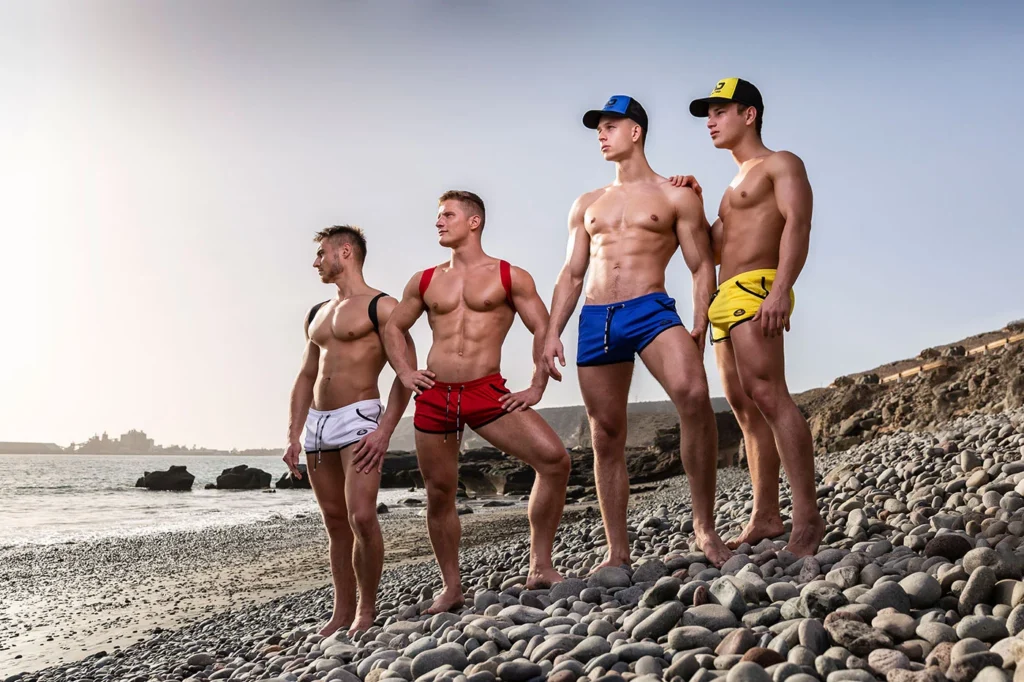
Croatia’s coast is usually sold at the brightest point of the year. The sea is warm, the terraces are full and the stone streets of the old towns carry more languages than any one person can place. The gay beach belongs to that picture. In Split, gay travel bloggers send visitors west of the old town to Kašjuni, a pebbly bay below Marjan hill. Part of the beach is signposted for naturists, and local gay men, the bloggers say, spend the warmer months there. For a queer visitor, that international crowd can create an immediate sense of ease. Nobody appears to own the pavement, or the pebbles; everybody is passing through.
But Split and Rijeka remain working cities after the last beach towels have left the balconies. People study there, care for parents, look for jobs, date, break up and decide how much of themselves to show in public. Their queer lives cannot be measured by the friendliness of a hotel desk or the mood of one crowded weekend.
Being visible for a holiday is one thing. Building a life that stays visible in February is another.
The crowd loosens the rules without settling them
Split’s historic centre offers a striking contradiction. A 2023 study commissioned by Split Pride, Queer Sport Split and queerANarchive asked 414 LGBTIQ people about life in and around the city. The report identified the old town as one of the public areas where respondents felt safer and freer. It connected that atmosphere to the international character of the centre, shaped by hospitality workers, businesses and visitors from many countries.
That finding will make sense to anyone who has spent a July evening in the old town. Gay Split in high summer is less a set of addresses than a crowd, and a crowd provides anonymity. Different clothes, languages and ways of carrying a body no longer attract the same attention when almost everyone looks newly arrived. Two men walking close together may feel less exposed among thousands of strangers than on a quiet street where every glance seems to last longer.
Yet the same study does not support an easy conclusion. Almost a quarter of respondents said they had experienced discrimination in cafés, restaurants or nightclubs. The report described more than 40 per cent of younger respondents as afraid of public places, and some altered their routes or behaviour to avoid insults, threats or violence. The relative comfort of the old town did not extend evenly across the city, the day or the year.
Tourism also squeezes Split as a place to live. In 2024, Euronews reported rents of €700 to €800 a month in a city where the average monthly salary was around €1,000, and a study commissioned by the city’s tourist board had found overtourism most pronounced in the crowded centre. None of that is specific to queer residents, but it explains the setting: the same season that can loosen social rules also strains housing, streets and neighbourhood life.

Visibility carries the memory of 2011
Public visibility in Split has a history that the summer postcard cannot hold. The first Split Pride, in June 2011, met organised hostility and serious violence. Amnesty International later reported that 44 of the 45 homophobic hate crimes recorded by Croatian police that year were connected to the march. Participants were attacked with objects and abuse while the police response proved inadequate for the threat.
That day matters because it shows what the simple act of walking openly through the city demanded. It also makes the continuity of Split Pride more significant than any attendance figure. On the evening of 27 June 2026, the fifteenth Split Pride set off from Đardin. The organisers focused on LGBTIQ students and the silence that schools can impose on young people.
The slogan, “Nije me mater rodila da mučin”, came straight out of Dalmatian speech. Roughly, it means “I wasn’t born to keep quiet”. The verb mučati means to keep quiet, and the Pride declaration turned that familiar word into an argument about what happens when silence is taught as a survival skill. It spoke about classrooms and changing rooms, teachers who hear an insult and continue the lesson, and young people who learn to lower their voices before they have the language to explain why.
This was not a borrowed festival slogan placed beside the sea. It was local in its dialect, its targets and its memories. The route through Split carried the weight of 2011, but the subject in 2026 was the next generation growing up in the same region.
A march needs rooms that remain open afterwards
A march can claim the street for an afternoon. Daily life requires rooms that remain available when there is no procession.
LGBT Centre Split is based in the old town and brings together Domine, queerANarchive, Queer Sport Split and Split Pride. Its programme combines legal and psychosocial support with workshops, exhibitions, screenings, radio, sport and social gatherings. The mix matters. A community does not live by crisis services alone, and culture is not an ornament added once the urgent work is finished. A film night, a sports session or an exhibition can be the first low-pressure way for someone to enter a shared space.
The centre’s location also changes the meaning of the historic core. The old town is not only where visitors make Split feel more cosmopolitan. It contains a permanent address created by local people for local people.
The 2023 study shows why that permanence is necessary. More than three quarters of respondents reported having experienced verbal or physical threat at least once. More than a third said they often considered leaving Split, while almost half thought about it sometimes. Those answers are not a verdict on every encounter in the city. They are a clear measure of the effort involved in staying.
A port city working on a longer clock
Rijeka sits on the same sea but carries a different civic rhythm. Its identity comes from the port, industry, migration and a cultural life that has long mixed institutional venues with independent organisations. The city’s 2020 European Capital of Culture programme called Rijeka a “Port of Diversity” and built its themes around water, work and migration. That language was not invented by queer organisers, but it created useful public ground for them.
Lesbian Organisation Rijeka, known as LORI, was founded in 2000 and is recognised as Croatia’s first registered lesbian organisation. That date matters more than a claim that Rijeka is simply liberal. It points to sustained local work: support, education, public advocacy and cultural production carried across changing governments and social moods.
LORI’s current activity includes psychological and peer counselling, legal advice, work with schools and mental-health professionals, youth programmes and social gatherings. Queer karaoke, walks and parties sit alongside help for people dealing with violence or discrimination. These are not the services of a seasonal party town. They answer the needs of people who are still there on an ordinary Tuesday.

Smoqua places queer life inside Rijeka’s own language
Rijeka’s clearest cultural expression of that approach is Smoqua, the international festival of queer and feminist culture launched in 2017. Its programmes have brought exhibitions, performance, workshops, talks, drag and public interventions into several parts of the city.
For the 2020 edition, the theme was Semo qua, “here we are” in the local Fiuman dialect. Like Split Pride’s use of Dalmatian language, the phrase placed queer presence inside the vocabulary of the city rather than presenting it as something imported.
Municipal support is also more visible in Rijeka. The city has flown rainbow flags from its administration building for the International Day Against Homophobia and Transphobia and for Smoqua, and it has publicly backed the festival. A flag does not eliminate discrimination, and a cultural reputation is not proof that every resident feels safe. Still, repetition matters. Local recognition has become expected rather than exceptional.
There is no single Adriatic scene
Split and Rijeka should not be arranged into a neat ranking of difficult and easy. Split has built a Pride tradition out of one of the most violent moments in Croatia’s recent queer history. Its community organisations now maintain a centre, produce art, organise sport and provide support in the heart of the city. Rijeka’s longer activist infrastructure and more explicit municipal language have created another model, but people there still need counselling, legal help and protection from violence.
The useful distinction is where visibility comes from. In Split, the summer crowd can open a temporary margin of freedom while local organisers work to make that freedom less dependent on tourism. In Rijeka, queer and feminist culture has grown through a network that belongs to the city’s year-round cultural identity. Both are coastal stories, but neither can be reduced to a list of friendly venues or beaches.
For visitors, the difference may be easy to miss. The sea looks equally blue, the beach bag holds little more than a towel and an ADDICTED swim brief, and a busy terrace can make acceptance seem complete. Residents experience a longer calendar. They know which spaces are comfortable after the season, which institutions will answer a call, where a young person can ask for help and who will still be organising when public attention moves elsewhere.
That is the Adriatic beyond the postcard: not a hidden scene waiting to be discovered, but communities already doing the work of remaining in view.
The sea is shared. The queer histories are local.
Split’s seasonal openness and Rijeka’s longer cultural infrastructure should not be collapsed into one travel label. Both cities are better understood through the organisations that remain after summer.