
GAY BUCHAREST / NIGHTLIFE AND CULTURE
Gay Bucharest has no district, but its queer night keeps finding a room
Gay Bucharest is held together less by a neighbourhood than by a changing network of parties, club nights, archives and community rooms. That makes it harder to map, and far more rewarding to follow.
A CITY WITHOUT A DISTRICT
Anyone who arrives expecting a compact quarter of rainbow flags and gay bars soon finds that Bucharest resists the map. A queer night here may begin with a message and an address.
A temporary room can carry more meaning than a district
There is no Bucharest equivalent of Schöneberg, Chueca or Soho. The city does have queer venues and recurring nights, Q Club among them, but much of its scene has learned to travel. A gathering may move from a flat to a mixed club night or a room whose purpose changes with the people inside it.
That movement sits at the heart of Waves Penetrate Me Fiercely, a 2026 short film by Romanian musician and sound designer Geo Aghinea. The film follows friends through flats, corridors, karaoke and an abandoned office that opens onto a DJ set. The locations feel provisional; the recognition between the people on screen does not.
Aghinea’s work records one young, artistic and trans experience of the city. It is not a survey of everyone who lives there. Plenty of queer people in Bucharest do not go clubbing. Age, income, gender expression and social circles can create very different versions of the same place.
The party did not always own the room
The city’s roaming nightlife predates the latest film. An oral history published by VICE Romania traced queer parties through clubs that opened, changed or disappeared. One strand began in 2010, when the performer Paul Dunca, also known as Paula Dunker, started Queer Night with two DJs. It was a queer party in the New York sense, open to everybody, held in a different straight venue each time.
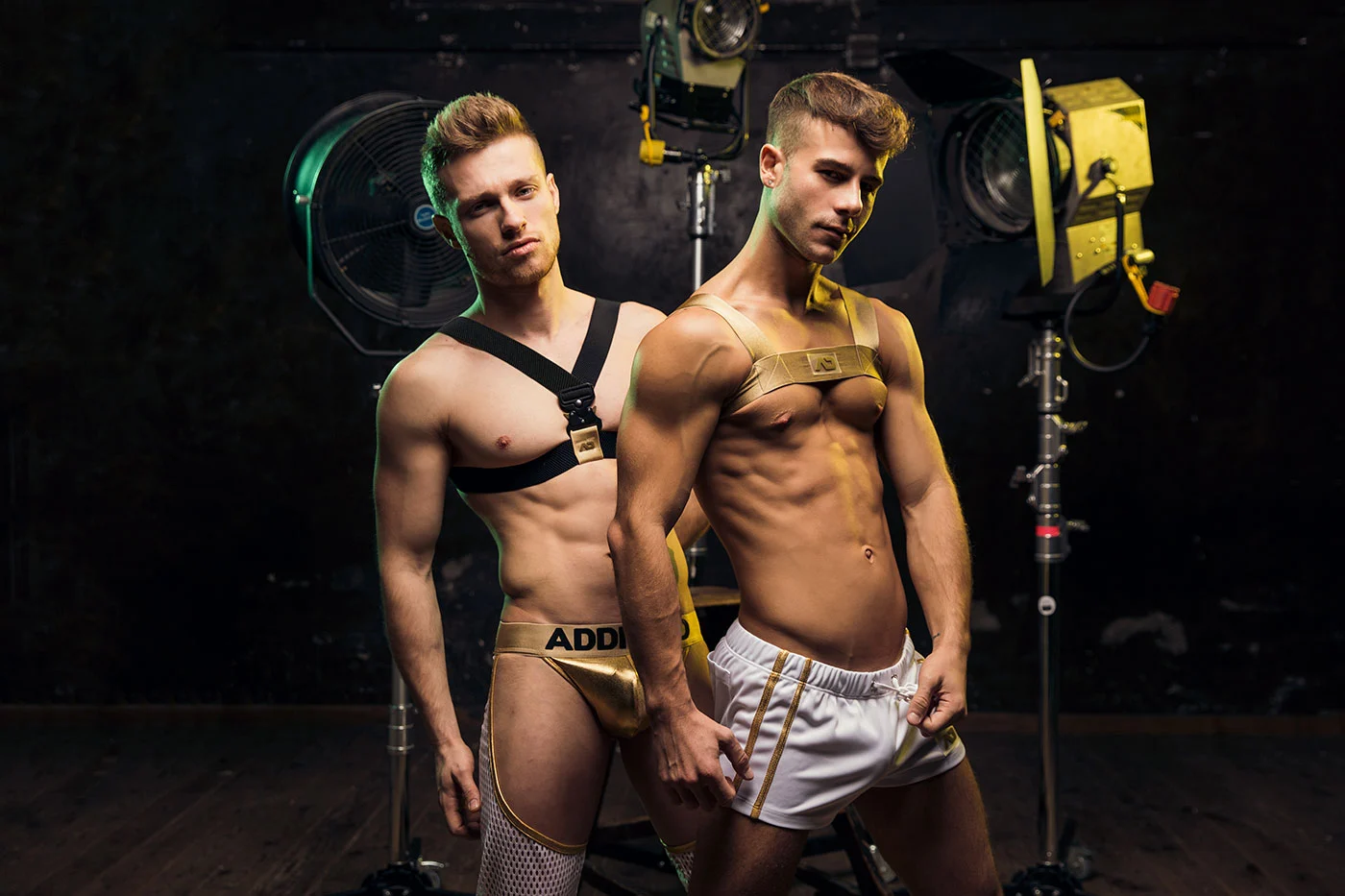
The aim was broader than recreating a conventional gay club. Queer performers, gay regulars, artists and straight friends could share the same floor without the night being built around a heterosexual audience. Dressing for the room was half the point, and it still is: something from the ADDICTED party collection for everyone to see, and ADDICTED underwear for whoever gets to see the rest.
There is a temptation to romanticise the arrangement: secret addresses, industrial rooms, a city revealed after midnight. But freedom inside a party does not automatically continue onto the street. In the Dazed interview around Aghinea’s film, harassment and caution in daylight are part of the story too. Pressure may create close bonds, but that does not make the pressure acceptable.
The scene does not disappear in daylight
Nightlife is only one part of queer Bucharest. In 2024 MozaiQ opened Q Center on Strada Arcului, a permanent community base with an information point, event rooms, a garden with a couple of resident cats and a FreeShop where people bring clothes and take what they need.
Through Rainbow Care, the organisation also offers social and career counselling, free therapy while places last and legal support. Film nights and community round tables share the calendar with those services.
That changes the geography of queer life. A dance floor can create release and solidarity, but it cannot replace legal advice, a therapy appointment or somewhere to spend an afternoon without buying a drink. Q Center is neither a club nor a gay district in miniature. It is a place where community can be sociable and useful at the same time.
MozaiQ’s Pride month in June 2026 showed that range. It opened on 6 June with a garden fair of queer initiatives at Q Center, complete with a grill, a Brazilian film, HIV testing and a crochet corner. The next day brought a guided walk through queer Bucharest. On the night of the march, the party moved to Q Club. Taken together, those dates say more about gay Bucharest than any list of bars.
A scene that changes address needs an archive
Spaces close, social-media pages vanish and stories remain attached to the people who were present. Romanian queer cultural projects have therefore begun treating memory as part of the city’s infrastructure.
MozaiQ’s Adrian Newell Păun Queer Archive digitised personal material and placed it within a wider account of local LGBTQ+ history. The project also included a tour of former gay bars in Bucharest. Later, the Museum of Queer Culture? project worked across literature, visual art and performance with institutional partners including the National Museum of Contemporary Art.
The question mark in the museum project’s name matters. A queer museum in Romania is not simply a finished building waiting to be filled. It is also an argument about whose art, bodies and memories are considered part of the country’s culture.
Aghinea’s film belongs to that developing record. So do old club flyers, photographs, oral histories and the memories of nights that never had a permanent home. Bucharest’s scene did not begin when it became visible to an international magazine, and it cannot be reduced to its newest party.
A strong night does not cancel a weak legal position
ILGA-Europe’s 2026 Rainbow Map placed Romania last among EU member states for LGBTQ+ laws and policies. Same-sex couples still lack comprehensive legal recognition despite European court judgments, while harassment and hate speech remain part of public life.
That is why nightlife should not be presented as a carefree escape from politics. In Bucharest the two often share a room: on 11 June, a MozaiQ silent party celebrated 100,000 signatures for civil partnership. People can build rooms where they feel free without having secured equal treatment outside them.
Perhaps that is why a conventional district map feels inadequate. Bucharest’s queer geography is made from routes rather than borders: a garden used for a community fair, an archive that remembers vanished clubs, a mainstream venue remade by its crowd, an office turned into a dance floor, breakfast after the music ends.
Some of those spaces are public. Others depend on trust. None speaks for every queer person in Romania. Together they describe a city whose community has repeatedly found a way to meet, make culture and take up room — even when that room was never originally offered to it.
No district. A real scene.
Gay Bucharest moves between nightlife, practical support, art and memory. The lack of a neat neighbourhood is not proof of absence. It is a clue to how the community has had to organise.