LGBT RIGHTS IN ROMANIA / 2026
LGBT rights in Romania, where visibility is growing faster than the law
Queer culture, Pride marches and community organisations are far more visible than they were a generation ago. Same-sex couples still have no legal status of their own. Both facts are needed to understand LGBT rights in Romania in 2026.

THE CONTRADICTION
Romania is not waiting for a queer community to appear. The community is already here. What remains unfinished is the state’s recognition of the lives people are already living.
Decriminalisation ended a crime. It did not create equality.
Article 200 made intimate relationships between people of the same sex a matter for criminal law. Romania committed to changing it when it joined the Council of Europe in 1993. Amendments adopted in the 1990s narrowed the offence, but retained language about acts committed in public or causing “public scandal”.
The full repeal came in 2001. Consensual same-sex relationships between adults were no longer treated as a separate criminal offence. ACCEPT, founded in 1996, had played a central role in that fight.
But decriminalisation answers only one question: can the state punish people for the relationship itself? It does not tell a couple what happens when their relationship needs to exist in law — for residence, property, inheritance, medical decisions or family protection.
A spouse for residence purposes, not marriage equality
The Coman case began with a same-sex couple who had married in another EU member state, a Romanian citizen and a spouse from outside the EU. When they sought to live together in Romania, the authorities would not treat the non-EU partner as a spouse for residence purposes.
The case reached the Court of Justice of the European Union. In 2018, the Court held that the word “spouse” in EU free-movement law is gender-neutral. An EU citizen who has exercised freedom of movement cannot be denied the right to live with a lawfully married same-sex spouse simply because the home country does not allow same-sex marriage.
The limit is important. The judgment did not require Romania to open marriage to same-sex couples. It required recognition for a specific purpose: allowing the couple to exercise EU residence rights and live together. Coman established an essential right, but it did not create a complete family-law status.

Private contracts are not a family-law system
The broader question reached the European Court of Human Rights in Buhuceanu and Others v. Romania. The case brought together 21 same-sex couples whose requests to marry had been rejected by local registry offices.
In May 2023, the Court found that Romania had violated the right to private and family life. It did not order the country to introduce same-sex marriage. It said the state had a duty to provide adequate legal recognition and protection, while retaining discretion over the form that protection should take.
The Romanian government argued that couples could organise some matters through private contracts. The Court rejected that as an adequate answer. Documents drafted one by one do not provide the same certainty as a legal framework that recognises the relationship itself.
Romania still has no general system of marriage or registered partnership for same-sex couples. On 27 May 2026, more than 100,000 signatures calling for civil partnership were delivered to the Chamber of Deputies, where the bills already filed were stuck in the legal affairs committee. A court has identified the obligation; Parliament has yet to turn it into an everyday status.

A 19 per cent score is about the state, not the people
ILGA-Europe’s 2026 Rainbow Map places Romania 42nd among 49 countries, with a score of 19 per cent. It is the lowest-ranked member of the European Union.
The number is severe, but it is easy to misuse. The Rainbow Map does not claim that 19 per cent of Romanians are accepting. It does not tell you whether a particular street feels safe or how visible queer culture is in Bucharest or Timișoara. It assesses laws and public policies across 76 criteria, including equality, family recognition, hate crime, legal gender recognition, intersex bodily integrity, civil-society space and asylum.
Romania’s position therefore describes an institutional deficit. A married couple facing a residence problem, a trans person seeking accurate documents and someone reporting a hate-motivated attack meet different parts of the state. Each needs rules that work before a crisis forces another individual case into court.
Community life did not wait for Parliament
ACCEPT marked its 30th anniversary in 2026. Its work has moved between courtrooms, support services and the streets: helping secure decriminalisation, documenting discrimination and violence, supporting people who need legal or social help and organising Bucharest Pride.
MozaiQ uses a community-based model. Through Q Center it offers social and career counselling, limited free therapy, legal support, cultural programmes and a place to meet. Its work pays particular attention to people who are often pushed to the edge even within LGBTQIA+ life.
In western Romania, Identity.Education works through art, culture, education, counselling and local community organising in Timișoara. The organisations are not interchangeable, and neither are the communities they serve. Visibility has grown through legal cases, volunteer teams, performances, archives, parties, public marches and quieter forms of care.
The public picture is larger than the law allows
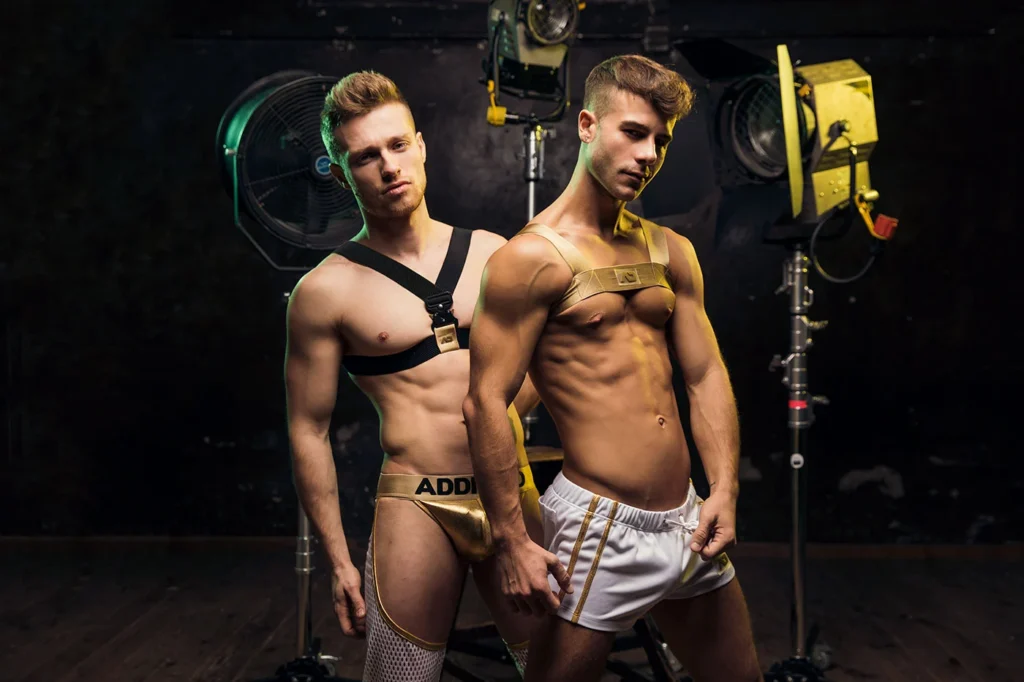
Bucharest Pride’s 2026 theme, “All of Us”, connected 30 years of ACCEPT’s work with the festival’s 21 editions. The programme stretched across film, theatre, dance, exhibitions, workshops and public debate. A new Pride Hub gave the festival a daily meeting place, and on 13 June about 35,000 people, a record by ACCEPT’s count, marched from Piața Victoriei to Pride Park beside the Palace of Parliament. On a day like that, getting dressed is part of the statement, and the ADDICTED Pride collection is made with that in mind.
That scale would have been difficult to imagine in 1996, when ACCEPT was founded and the fight for gay rights in Romania was still a fight against the criminal code. It also makes the present contradiction impossible to ignore. Queer life is public, organised and culturally present. Same-sex couples still lack an ordinary legal status, and European judgments have not yet become a coherent domestic framework.
Romania has travelled a long way from Article 200. The next distance is not abstract: it lies between being visible and being recognised.
The community is here. Recognition is late.
Decriminalisation, public visibility and community institutions have changed Romania. Family law has not caught up. The Coman and Buhuceanu decisions explain both the progress and the gap.